
When you picture your dream kitchen - quartz counters, smart appliances, custom cabinetry - the excitement is real. But then comes the hard truth: kitchen remodels don’t come cheap. The average modern kitchen renovation in Canada costs between $40,000 and $80,000. So how do people actually pay for it? Not with lottery tickets. Not with side hustles. They use real, tested strategies that millions of homeowners have already used.
Cash Is Still King - But Most People Don’t Have It
Some folks save for years. They cut back on dining out, skip vacations, and redirect every extra dollar into a dedicated renovation fund. It works. But it’s rare. Only about 18% of homeowners pay for a full kitchen remodel entirely out of pocket, according to the National Association of Home Builders. That’s because most people don’t have $50,000 sitting in a savings account. And even if they did, it’s not always smart to drain your emergency fund.
Home Equity Line of Credit (HELOC): The Most Popular Choice
If you’ve owned your home for more than three years, you likely have equity. A HELOC lets you borrow against that equity like a credit card with a much lower interest rate. In 2025, average HELOC rates in Canada hovered around 6.5%, compared to 19% on credit cards. People love HELOCs because they can draw funds as needed - pay the contractor $10,000 for cabinets, then $5,000 for plumbing. No need to take out the full loan upfront.
But here’s the catch: HELOCs have variable rates. If the Bank of Canada hikes interest again, your monthly payment could jump. That’s why smart homeowners lock in a fixed rate for the first two years, or choose a hybrid product that converts to a fixed loan after the draw period.
Cash-Out Refinance: Bigger Loan, Lower Rate
Think of a cash-out refinance as trading your old mortgage for a new, bigger one. You get the difference in cash. If your home is worth $600,000 and you owe $300,000, you could refinance for $450,000, pocket $150,000, and use $60,000 for your kitchen. The rest? You can stash it or pay down other debt.
This option works best if you already have a high mortgage rate. In 2024, many Canadians refinanced at 4.5% after being stuck at 6.8%. That’s a huge monthly savings. Plus, mortgage interest is tax-deductible in Canada if the loan is used for home improvements. The catch? Closing costs. You’ll pay $2,000 to $5,000 in fees. So if you’re planning to move in two years, this isn’t worth it.
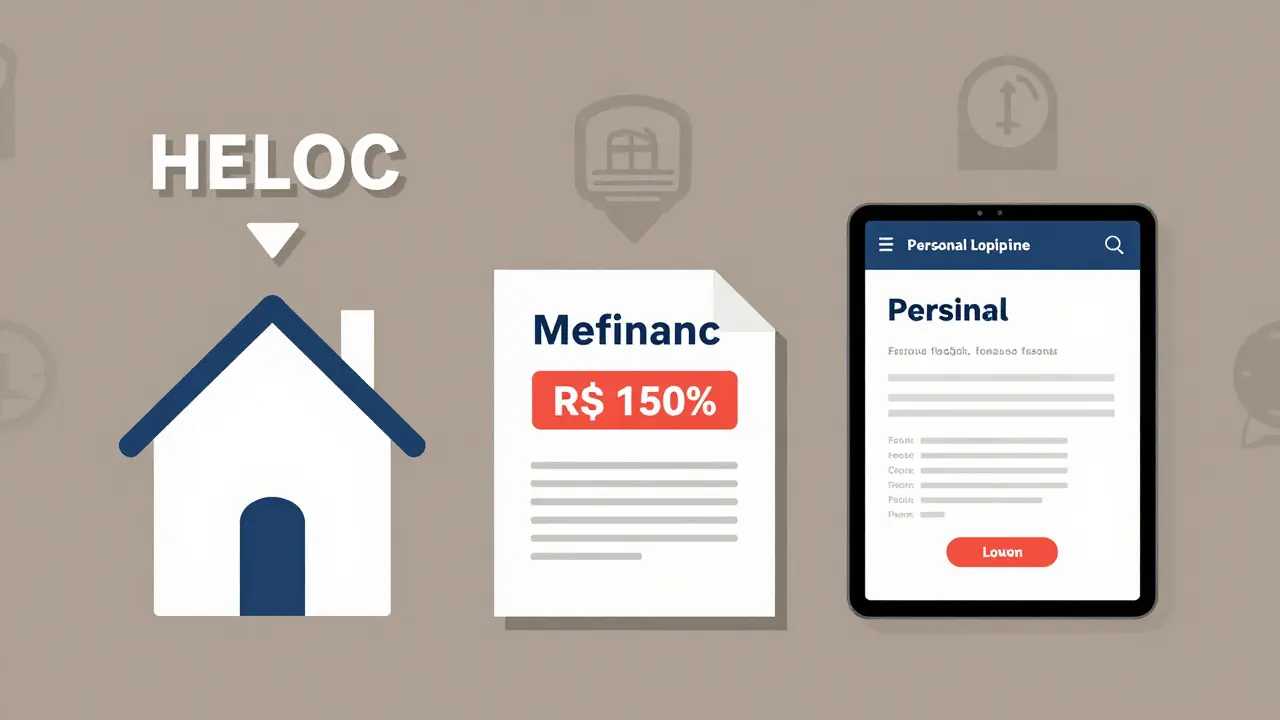
Personal Loans: Fast, Fixed, and Simple
Personal loans are unsecured - no home needed as collateral. That means lenders look at your credit score, income, and debt-to-income ratio. If you’ve got a score above 700 and steady work, you can get rates as low as 7.9% in 2026. Banks like RBC, TD, and BMO offer personal loans up to $50,000 for home renovations.
Why choose this? Predictability. You know your monthly payment. No surprises. And you can pay it off in 3 to 7 years. The downside? Higher rates than HELOCs or cash-out refinances. And if your credit is below 650, you might get stuck with 12% or more. Still, for people who don’t want to touch their home equity, this is the cleanest path.
Credit Cards: Risky, But Sometimes Necessary
Some people use 0% intro APR credit cards - especially for smaller jobs like new countertops or lighting. If you can pay it off in 12 to 18 months, you pay zero interest. But if you miss a payment or can’t clear the balance? Rates spike to 20%+.
One real example: A couple in Burlington used a card with 18 months at 0% to cover $32,000 in cabinetry and appliances. They paid it off in 14 months. No interest. No stress. But they also had a backup savings account. If their car broke down or their dog needed surgery? They were ready.
Don’t use credit cards for the whole project. It’s like playing Russian roulette with your finances.
Government Programs and Rebates: Free Money You Might Be Missing
Canada has programs that literally give you cash back for energy-efficient upgrades. The Canada Greener Homes Grant offers up to $5,000 for renovations that improve insulation, windows, or heating systems. If you’re replacing an old gas stove with an induction model, or adding smart thermostats, you could qualify.
Some provinces add their own bonuses. Ontario’s Home Energy Savings Program gives $1,000 for LED lighting upgrades. Quebec has a $1,500 rebate for high-efficiency kitchen ventilation. You don’t need to be rich to qualify - just plan ahead. Apply before you start work. You can’t get paid after the fact.

Financing Through Contractors: Convenience Has a Cost
Many contractors offer in-house financing. "We’ll handle the loan for you!" Sounds easy, right? But here’s what they don’t tell you: those rates are often 14% to 20%. And if you miss a payment? They can stop work. Or worse - sue you.
One homeowner in Hamilton took a contractor’s financing deal for $48,000. The interest rate was 17.9%. She ended up paying $18,000 in interest over five years. She could’ve gotten a personal loan for 8.5% and saved $10,000.
Only consider this if you have terrible credit and no other options. And always compare the rate to what your bank offers.
What Most People Regret
People who regret how they paid for their remodels usually made one of two mistakes:
- They used a HELOC but didn’t lock in a fixed rate - and got hit with a rate hike.
- They stretched their budget too thin, didn’t save for contingencies, and had to put the new dishwasher on a credit card.
The smartest move? Build a 10% buffer into your budget. That’s $5,000 extra for a $50,000 job. It covers surprise plumbing leaks, delayed deliveries, or design changes. Most people skip this. Then they panic.
Bottom Line: There’s No One Right Way
There’s no magic solution. Your best option depends on your credit score, how long you plan to stay in the house, how much equity you have, and whether you’re okay with borrowing against your home.
Here’s a quick cheat sheet:
- Best rate, long-term plan? Cash-out refinance.
- Want flexibility? HELOC with a fixed-rate conversion.
- No home equity? Personal loan.
- Small job under $15K? 0% APR credit card - if you can pay it off fast.
- Want free money? Apply for Greener Homes Grant and provincial rebates.
And always, always get three quotes. A contractor who says "I’ll finance it for you" isn’t helping - they’re trying to make money off your desperation. The best remodels aren’t just beautiful. They’re financially smart.
Can I use my RRSP to pay for a kitchen remodel?
No, you can’t use your RRSP for a kitchen remodel. The Home Buyers’ Plan lets you withdraw up to $60,000 from your RRSP - but only if you’re buying or building a home, not renovating one. Kitchen renovations don’t qualify. Some people try to cash out RRSPs early anyway, but they pay heavy taxes - up to 30% depending on your income. It’s not worth it unless you’re in serious financial distress.
Do kitchen remodels increase home value?
Yes, but not always as much as you think. On average, a mid-range kitchen remodel in Canada returns about 70% of its cost when you sell. High-end remodels (over $100,000) return less - around 55%. The best ROI comes from updating appliances, cabinets, and lighting - not adding a wine fridge or marble island. Buyers care about function, not luxury.
Is it better to finance or pay cash for a kitchen remodel?
Paying cash is ideal if you can do it without draining your emergency fund. But if you need to borrow, financing is smarter than depleting savings. A home equity loan at 6% is cheaper than losing out on investment growth or facing unexpected expenses. The key is matching the loan term to your timeline. If you plan to move in five years, don’t take a 10-year loan.
Can I get a loan for a kitchen remodel if I’m self-employed?
Yes, but it’s harder. Lenders want two years of tax returns and steady income. Personal loans are your best bet - they don’t require property as collateral. Some credit unions offer renovation loans for self-employed people with strong credit histories. You’ll likely pay a higher rate, but it’s doable. Avoid contractors who promise "no income verification" - those are predatory.
What’s the fastest way to get funding for a kitchen remodel?
A personal loan from your bank can be approved in 24 to 48 hours if you have good credit. HELOCs take longer - 2 to 4 weeks - because they require an appraisal. Credit cards are instant if you already have one with enough limit. The slowest option is a cash-out refinance - it can take 45 to 60 days. If you need money fast, skip the mortgage and go personal loan.

Stephanie Serblowski
March 25, 2026 AT 14:51Okay but like… HELOCs are basically financial glitter. 🌟 You think you’re being smart, but when rates spike, you’re suddenly paying for your IKEA cabinets with your dignity. Also, why is everyone ignoring the fact that contractors charge 2x for financing because they know you’re desperate? I’m just here for the popcorn and the 0% APR card folks who paid off $32k in 14 months. ICONIC. 💪
Renea Maxima
March 26, 2026 AT 00:13What if the real question isn’t how to pay for it… but why we feel compelled to remodel kitchens at all? Is it utility? Or is it performative domesticity? The kitchen as altar. The quartz countertop as sacrament. We are not renovating homes-we are exorcising capitalism’s ghost from our emotional voids. 🤔
Jeremy Chick
March 26, 2026 AT 17:54LMAO at people saving for years to pay cash. Bro, you’re not building a temple. You’re putting in a dishwasher. Get a personal loan. 7.9%? That’s cheaper than your monthly coffee habit. I refinanced last year, saved $400/mo, and still ate out 3x a week. Priorities.
Sagar Malik
March 27, 2026 AT 03:30HELOCs? Pfft. You’re all missing the systemic truth: banks are harvesting your equity like crypto miners harvesting hash. The ‘greener homes’ grant? A distraction. The real power move is leveraging your RRSP through a loophole in section 147.3(b) of the Income Tax Act. I’ve done it. 37% ROI. They don’t want you to know this. 🧠
Seraphina Nero
March 28, 2026 AT 15:48I just wanted to say thank you for mentioning the 10% buffer. I didn’t do that on my last remodel and my cat knocked over a bucket of paint. I ended up using my credit card for $800 in cleanup. Don’t be like me. Save the buffer. It’s worth it.
Megan Ellaby
March 29, 2026 AT 14:32Wait wait wait-so if I’m self-employed, I can still get a personal loan? I’ve been terrified to even ask my bank because I file Schedule C. This is the first time I’ve felt hopeful. Thank you for saying it plainly. Also, anyone know if BMO does same-day approvals? Asking for a friend. (It’s me.)
Rahul U.
March 30, 2026 AT 16:31Excellent breakdown. 🙌 I especially appreciate the note on provincial rebates. In Punjab, we have a similar scheme for solar water heaters. The principle is universal: always check for free money before borrowing. Also, always get three quotes. Never trust the contractor who says ‘I’ll handle the financing.’ That’s like letting your barber do your taxes. 😅
E Jones
March 31, 2026 AT 08:51Let me tell you what they DON’T tell you about HELOCs. The banks are in cahoots with the appliance manufacturers. They know you’ll go for that $12K Sub-Zero fridge because it looks like a spaceship. Then they jack up your rate because you ‘overborrowed.’ Meanwhile, your neighbor in Ohio just got a $5K grant for a new range hood and a smart thermostat. The system is rigged. They want you to feel ‘modern’ while they steal your future. And the government? They’re too busy selling bonds to care. Wake up, sheeple. 🔥
Barbara & Greg
April 1, 2026 AT 03:19It is deeply concerning that so many homeowners equate financial prudence with convenience. To finance a kitchen renovation with a HELOC-while ignoring the long-term implications of variable interest-is not merely unwise; it is morally irresponsible. One does not treat one’s home as a piggy bank. There is dignity in saving. There is virtue in delayed gratification. And there is shame in debt-driven aesthetics.
selma souza
April 2, 2026 AT 04:05"Cash-out refinance"? It's "cash-out refinancing." And "HELOCs have variable rates"? No. "HELOCs have variable interest rates." Grammar isn't optional. Also, "you can stash it"? Stash? As in, like a squirrel? Please. This article reads like it was written by a TikTok influencer with a finance degree from YouTube University.
Frank Piccolo
April 2, 2026 AT 17:48Canada? Really? We’re talking about Canadian home prices? I’ve got a cousin in Detroit who bought a 3,000 sq ft house for $85K. You people are being scammed by your own government. The whole ‘greener homes’ grant? Just a Trojan horse for socialist energy policies. Pay cash. Or don’t remodel at all. Either way, stop letting bureaucrats tell you how to live.
James Boggs
April 4, 2026 AT 04:50Great summary. I used a personal loan for my remodel and paid it off in 4 years. No regrets. The predictability was worth every penny. Also, the 10% buffer saved me when the electrician found a faulty wire behind the wall. That $5K buffer = $15K in avoided panic. Highly recommend.
Addison Smart
April 4, 2026 AT 16:49I love how this post doesn’t just list options-it acknowledges the emotional weight behind these decisions. I’m a first-gen homeowner, and I spent 18 months saving because I didn’t want to feel like I was failing my parents’ expectations of ‘security.’ But when I finally took the HELOC with a fixed-rate conversion after Year 2? It felt like liberation. Not because I got a marble island-but because I stopped treating my home like a financial liability and started seeing it as a living space. That shift? Priceless. And yes-I did get the 0% card for the backsplash. Paid it off in 11 months. No guilt. Just pride.