
Imagine this: you walk into a living room store, touch a velvet cushion, and feel instantly in love. Two weeks later, the delivery truck arrives. Another month passes, and you're staring at a dent in the corner while calculating your credit card interest rate. It happens more often than you'd think here in Burlington. We treat sofas like disposable tech sometimes, forgetting they anchor our living space for a decade.
So, how much is actually too much? There isn't a magic number stamped on every tag, but there are clear lines where value stops paying off. If you are reading this, you likely want to stop second-guessing your receipt.
The Quick Take
- Aim to spend between 1% to 3% of your annual household income on a primary sofa.
- Cheap couches under $800 usually last 3 years; mid-range models last 7 to 10 years.
- Pay extra for solid hardwood frames and eight-way hand-tied suspension systems.
- Avoid high-interest financing; pay cash or wait for interest-free promotions.
- Warranties longer than five years often hide manufacturer confidence issues.
The Real Cost Equation
We need to talk numbers. In March 2026, inflation has stabilized slightly compared to the previous year, but furniture manufacturing costs remain tight. A common mistake is looking at sticker price alone without factoring longevity. If you buy a Sofa Pricing model for $600 and replace it three times over ten years, you've spent $1,800. If you buy one for $1,500 once, you saved money despite the higher initial hit.
A solid heuristic for this decision involves your lifestyle. How many people sit on the couch daily? Do you have pets? Kids who run across the fabric? In Canadian homes where we spend months indoors due to winter, the usage hours spike dramatically. Here is a breakdown of where your dollar buys you value:
| Category | Price Range (CAD) | Expected Lifespan |
|---|---|---|
| Budget Entry | $500 - $900 | 2 - 4 Years |
| Mid-Range Quality | $1,200 - $2,500 | 7 - 10 Years |
| Premium Investment | $3,500+ | 15+ Years |
If your budget is tight, focus on durability. You might not get premium leather, but you can demand better materials elsewhere. Conversely, if you can afford more, does jumping from $2,000 to $5,000 buy twice the comfort? Usually not. Diminishing returns kick in hard past the $3,000 mark unless you are seeking antique restoration pieces or bespoke design.
What Drives the Price Tag?
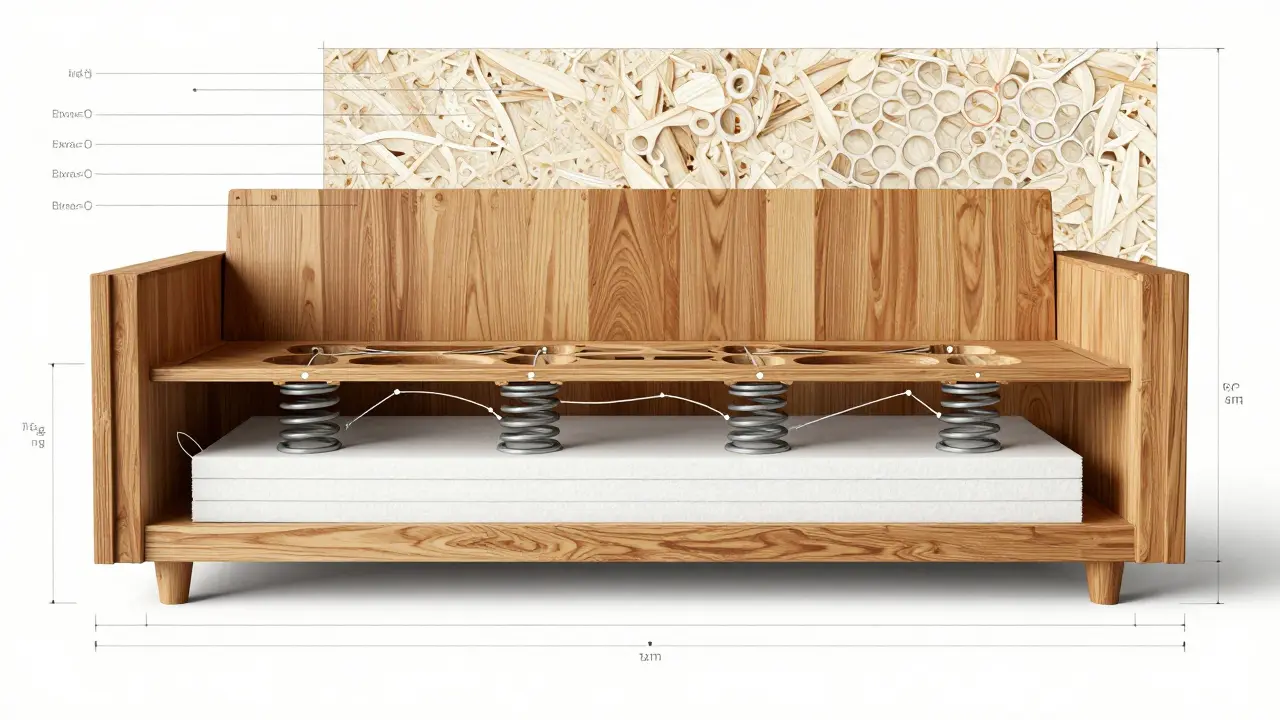
You don't pay for style alone; you pay for internal mechanics. When a salesperson tells you why a chair costs $4,000, listen for these specific keywords.
Solid Hardwood Frame is the structural skeleton of high-quality furniture made from oak, maple, or ash rather than soft pine or particleboard. Particleboard rots under humidity, which is common in basement dens here in Ontario. You want hardwood. It resists warping when you open windows in spring rain.NEXT comes suspension. Cheap units use sinuous springs-those S-shaped wires that sag. Look for Eight-Way Hand-Tied Springs. These connect the frame to the cushions individually. They provide consistent bounce and resist sagging over years of sitting. Without this system, your bottom half sinks into the seat after two years.
Fabric matters, but specifically the weight and rub count. A standard polyester blend tears easily. Fabric Rub Count refers to a measure of abrasion resistance tested by rubbing a piece of abrasive cloth against the textile. Anything below 10,000 double rubs is risky for daily family use. High-density foam is another term to look for. Low-density foam turns to mush quickly. Ask specifically for density ratings, often measured in pounds per cubic foot. You want at least 1.8 lbs.
When You Are Definitely Overpaying
Luxury labels carry massive premiums. Sometimes the brand name costs more than the oak wood inside. Be wary of retail stores that push financing aggressively. If you see monthly payment plans advertised prominently on window displays, that's a signal they need volume, not necessarily profit per unit.
Here is the trap: Extended warranties. Manufacturers sell 5-year protection for $300. Read the fine print. Most claim damage is excluded for normal wear and tear anyway. If the cushion breaks or the stain sets, you are out of luck. That $300 is better used to upgrade the fabric to something washable or stain-resistant initially.
Also consider the source. Local artisans here in the Quebec-Montreal corridor offer incredible craftsmanship. However, import goods from China have improved. Don't assume local is automatically better unless you verified the wood sourcing. Import tariffs in 2026 still exist on certain timber types, so ask where the raw materials originated.
Financing and Payment Terms in 2026
Credit markets are tighter than they were in 2024. Interest rates hovered higher throughout the last few years. Using store credit to buy furniture is rarely smart math.
If you buy on credit:
- Check if it is 0% interest for 12 months. If you pay off the full amount within that window, you gain cash flow flexibility.
- Avoid deferred interest schemes. If you owe even $1 remaining after the promo period, the retailer charges back interest from day one.
- Look at personal loan rates. Many banks offer lower APRs than retailer proprietary cards.
Saving up is boring but effective. Set aside $100 weekly. By winter, you have $2,500 in cash. Cash gives you leverage to negotiate discounts on floor models. Stores prefer moving inventory over holding stock for storage fees.
Extending Your Couch Life
Buying is only step one. Keeping it looking good saves you from buying again too soon. Leather Conditioning prevents cracking. Do this twice a year with neutral pH products. Never leave the leather near radiators.
Rotating cushions weekly helps distribute wear. Flip throw pillows so one side doesn't get crushed permanently. Vacuum under the cushions monthly to remove crumbs and dust bunnies that break down foam compression.
Is a sectional worth more than a standard sofa?
Generally, yes. Sectionals have complex joining mechanisms where corners meet. They require robust framing. However, they occupy more floor space and limit future reconfiguration of your room layout.
Should I buy a recliner mechanism?
Mechanical recliners fail faster than static furniture. Motorized recliners last longer but cost significantly more due to electrical components. If comfort is paramount, invest here. If aesthetics matter more, choose static seating.
Are white sofas practical in 2026?
It depends on the fabric technology. Nano-coated linen or synthetic blends repel liquids well. Natural silk or untreated cotton will yellow or stain immediately. If you choose white, verify the fabric warranty covers stains.
How long should delivery take locally?
Standard lead times are 4 to 8 weeks for custom orders. Stock items can arrive in 3 days. Avoid retailers promising impossible speeds unless they have massive warehouse stock nearby.
Can I return a big ticket item?
Returns policies vary wildly. Some charge restocking fees up to 20%. Custom made items are almost always non-returnable. Always read the policy before signing the contract.

Rohit Sen
March 31, 2026 AT 22:49Genuinely interesting perspective on diminishing returns past three thousand dollars. Most people confuse costliness with quality when they really lack refinement. I prefer bespoke Italian leather regardless of inflation trends. True value is found in the joinery rather than the fabric label. Stick to your guns on the hardwood frame suggestion.
Vimal Kumar
April 1, 2026 AT 20:00I think everyone should read up on the particleboard warning before they buy anything cheap. It ruins your living space way faster than you expect. My cousin learned this lesson the hard way last winter. Spending a bit more upfront saves you stress later on.
vidhi patel
April 1, 2026 AT 20:02Your syntax suggests a lack of academic rigor regarding the economic factors presented here. One does not simply claim refinement without substantiating the technical specifications involved. The assertion regarding Italian leather lacks empirical backing in the current market context. Please refrain from making unsubstantiated claims next time.
Amit Umarani
April 2, 2026 AT 09:38The article mentions rubber counts incorrectly in the third section. You should know that rub count applies to abrasion resistance specifically. Also the formatting on the table headers was quite messy. People need to proofread before publishing guides like this online.
Priti Yadav
April 3, 2026 AT 12:53Yeah because the manufacturers dont want you knowing the real wear rates either. They plan obsolescence into everything we touch nowadays. Its obvious they are trying to keep us buying new things constantly. Watch out for those warranty terms closely.
Noel Dhiraj
April 5, 2026 AT 10:40You really need to stop thinking about money for a moment and think about your own comfort levels. Life is too short to sit on something that makes your back hurt every day. Investing in your health through furniture is actually the best decision you can make. Saving cash now means spending more later when your body fails you. Do not let greed dictate your personal physical well being choices today. Think about how many hours you spend relaxing in that spot weekly. Your family needs a safe place to gather and talk about their days together. Cheap stuff falls apart and leaves you feeling frustrated with every broken spring. Quality materials breathe better and handle humidity much more effectively for you. Take the time to visit the store and feel the wood yourself honestly. Bring a friend along who cares about your happiness and home setup goals. Listen to your intuition when you sit down on a frame and test it out properly. If it feels good then trust that feeling over what someone else tells you online. Financial stress comes from ignoring your needs until it is too late to fix. A good couch is a foundation for a healthy mental state during the long winters ahead.
Jen Deschambeault
April 6, 2026 AT 11:30That is truly wonderful advice for anyone struggling with their savings decisions.
Kayla Ellsworth
April 7, 2026 AT 18:04Captains gonna get rich off our backs no matter what we pick.
Soham Dhruv
April 8, 2026 AT 19:54i think ur kinda right bout the prices going up everywhere these days though. its crazy how much timber costs now in ontario too. maybe just save cash till you find a deal that makes sense. dont rush into anything weird.
Kasey Drymalla
April 9, 2026 AT 00:55they tell us wait but they know we cant afford to sleep anywhere else. corporations design items to break before insurance pays out fully. nobody talks about the glue toxicity in the foam anymore honestly. keep your cash close and dont let them sell you garbage. watch the shipping fees hide the true cost of ownership.