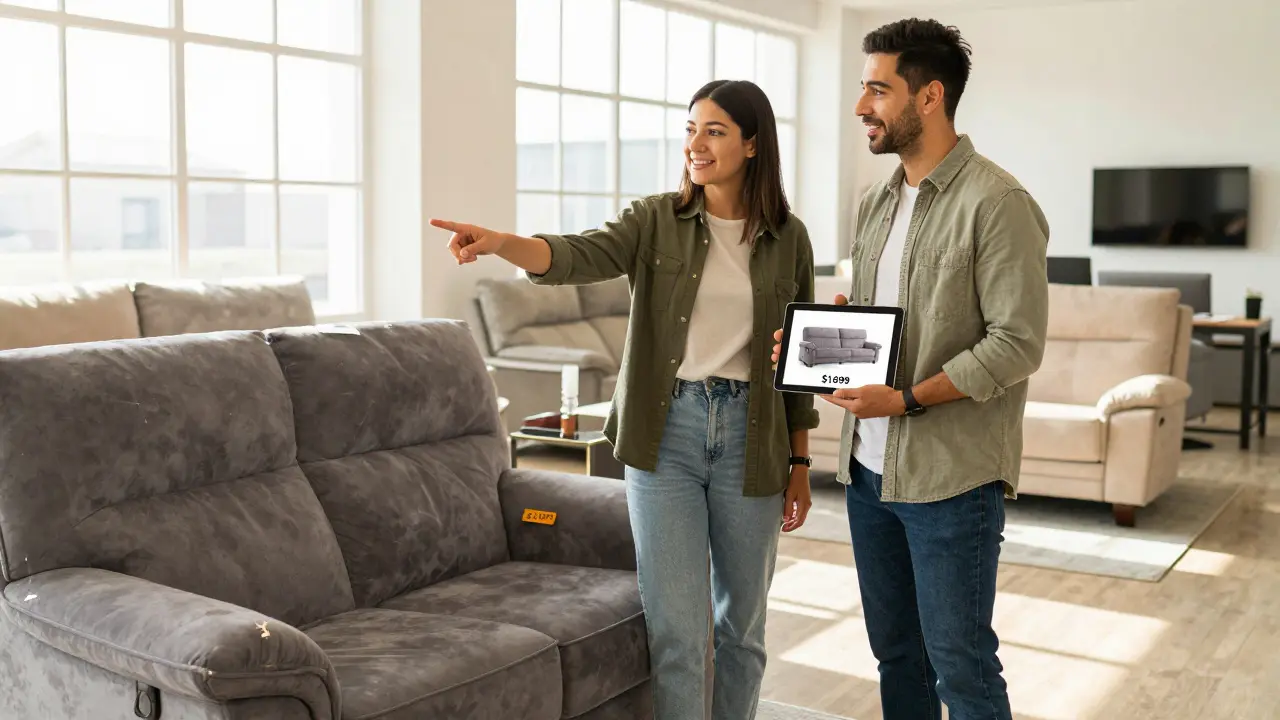
Ever walked into a furniture store, fell in love with a sofa, and then froze when you saw the price? You’re not alone. Most people assume the sticker price is final-like it’s carved in stone. But here’s the truth: negotiating when buying furniture isn’t just possible, it’s expected. In fact, many stores build in 20-40% room for negotiation right from the start. If you don’t ask, you’re leaving money on the table-sometimes hundreds of dollars.
Why Furniture Prices Are So Flexible
Furniture stores don’t operate like grocery stores. You won’t find a fixed markup on a couch like you would on a carton of milk. Instead, furniture pricing is built on layers: wholesale cost, shipping fees, store overhead, and then a wide profit margin. Most retailers plan to sell items at full price only if they have to. The rest? They’re ready to move inventory quickly, especially at the end of a season, during slow months, or if an item has a minor flaw.Think about it: a sectional sofa that costs $2,800 new might have been sitting in the showroom for six months. The store’s cost to store it, insure it, and keep it dust-free adds up. For them, selling it for $1,800 is better than letting it gather dust. That’s where negotiation kicks in.
When to Negotiate (And When Not To)
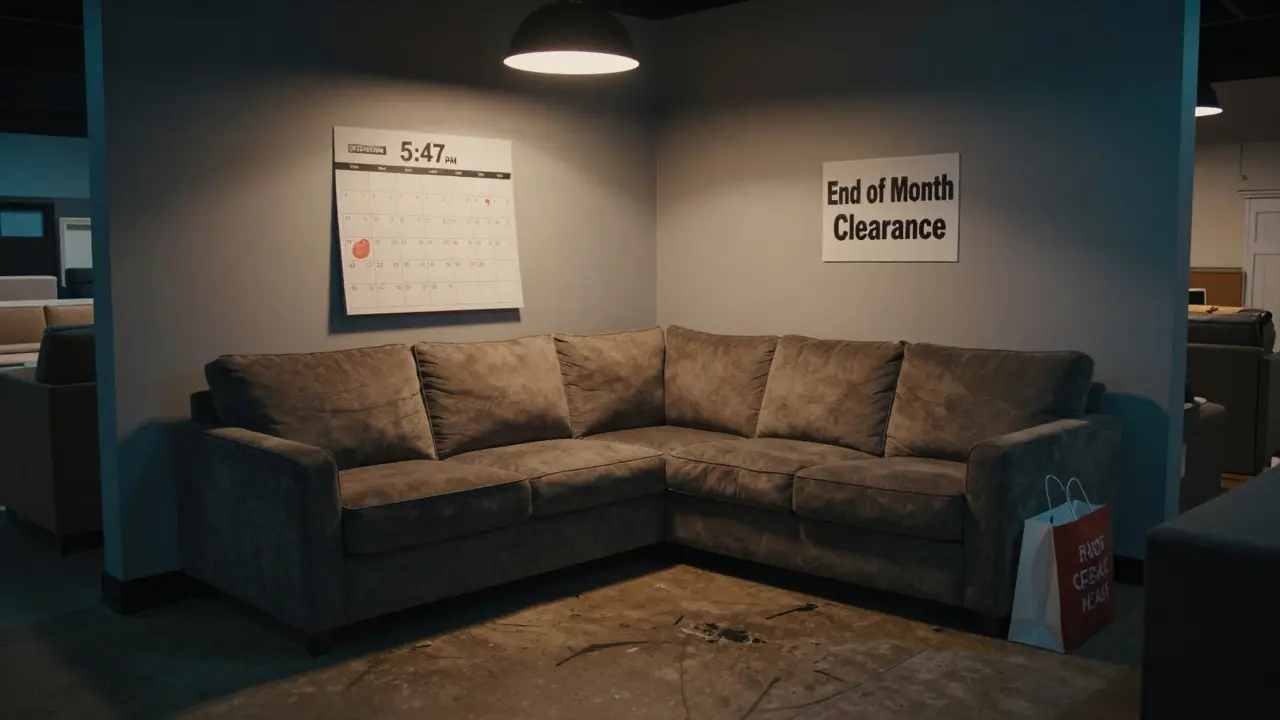
Timing matters more than you think. The best windows to negotiate are:- End of the month: Sales reps are chasing quotas. They’ll bend rules to hit their numbers.
- End of the season: Spring clearance for winter pieces? Fall clearance for outdoor furniture? That’s when discounts are deepest.
- Monday through Thursday: Weekends are busy. Weekdays mean less foot traffic and more willingness to close a deal.
- Just after a holiday: After Black Friday, Memorial Day, or Labor Day, stores clear leftover stock.
- If an item has a dent, scratch, or missing cushion: Even a tiny flaw can be your leverage.
Don’t waste your time negotiating at high-end luxury boutiques or brands like Restoration Hardware during their full-price launches. Those places rarely budge. But at big-box chains like IKEA, Ashley Furniture, Raymour & Flanigan, or local independent stores? Always try.
How to Negotiate Without Sounding Desperate
You don’t need to haggle like a street vendor. A calm, polite approach works better. Here’s how:- Do your homework. Check the same sofa on Amazon, Wayfair, or even at a competing local store. Take screenshots. If you find it cheaper elsewhere, say: "I saw this exact model at XYZ for $1,950. Can you match that?"
- Bundle your purchase. If you’re buying a sofa, coffee table, and rug, say: "I’m looking to buy all three today. Can you give me a package deal?" Most stores will offer 10-15% off for multiple items.
- Ask about floor models. "Is this floor model available at a discount?" Floor models are often 15-30% off because they’ve been handled, even if they look new.
- Use cash or financing. "I can pay cash today" or "I’m approved for store financing" can trigger instant discounts. Cash means no processing fees for them. Financing means they make money on interest.
- Be ready to walk away. Don’t act like you’re desperate. Say: "I really love this, but I need to think about it." Then leave. Often, they’ll call you back with a better offer.
What to Say (And What Not to Say)
Your words matter. Here’s what works:- "I’m ready to buy today if we can work out a price."
- "Is there any room for adjustment on this item?"
- "I’ve been looking at several options. What’s the best deal you can offer me?"
Avoid these phrases:
- "I’m on a tight budget." (They’ll assume you’ll never pay more, even if you can.)
- "Can you make it cheaper?" (Too vague. Always give a reason or a number.)
- "I’ll take it if you throw in free delivery." (This sounds like a demand, not a request.)
Real-World Example: What Happened in Burlington
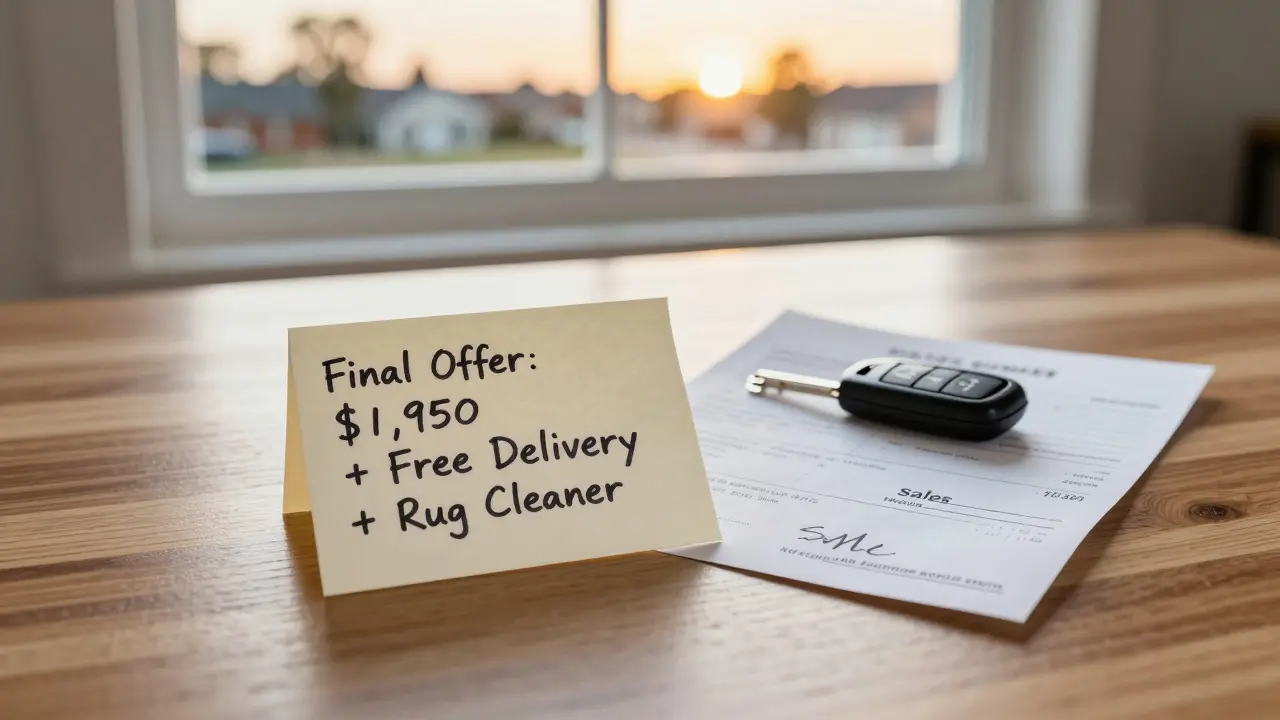
Last fall, a local resident bought a 3-seater velvet sofa from a Burlington furniture store. The tag price was $2,199. She mentioned she’d seen it for $1,899 at a nearby outlet. The salesperson checked their system, then said: "I can do $1,950, and I’ll throw in free delivery and a free rug cleaner." She walked out paying $1,950-$249 less than the original price, plus two free extras. That’s a 11% discount with added value.What You Might Be Missing: Extended Warranties and Delivery Deals
Negotiation doesn’t stop at the price. Ask for:- Free delivery (often $150-$300 value)
- Free assembly (especially for beds, bookshelves, or modular systems)
- Extended warranty (sometimes offered at cost, or even free if you buy above a certain amount)
- Same-day pickup (if the item is in stock, stores will waive delivery fees to avoid handling it)
One customer in Oakville saved $280 by asking for free delivery on a dining set. The store had two identical sets in stock-they were happy to waive the fee just to move one.
Common Myths About Furniture Negotiation
Let’s clear up some myths:- Myth: "Big stores don’t negotiate." Truth: IKEA, Ashley, and even Costco have discount programs for bulk, floor models, or end-of-season sales.
- Myth: "Only cash buyers get discounts." Truth: Financing can be more valuable to stores than cash because of interest revenue.
- Myth: "If I ask once, I’ve tried." Truth: Some stores let you negotiate twice. Go back a week later. Ask for a manager. Say: "I still really want this. Can we revisit the price?"
When Not to Negotiate
There are times to pay full price:- Buying a one-of-a-kind artisan piece
- Purchasing from a small, local maker who barely breaks even
- Getting a custom-built item (like a made-to-order sectional)
In those cases, you’re paying for craftsmanship, not markup. But for mass-produced furniture? Always ask.
Final Tip: The Power of the Written Quote
If a salesperson gives you a better offer, say: "Can you email me that quote?" That makes it official. It also gives you time to compare, and it creates accountability. If they don’t follow up, you can say: "I was told you’d send me the final price. Did that get lost?" Most of the time, they’ll send it-and sometimes even improve it.Remember: furniture stores want to sell. They’d rather move 10 sofas at $1,800 than sit on 10 unsold ones. You’re not being rude-you’re being smart. And in a market where people pay full price out of habit, you’re already ahead.
Is it rude to ask for a discount on furniture?
No, it’s not rude. In fact, most furniture retailers expect it. Many stores build in 20-40% negotiation room right into their pricing. Asking for a discount is part of the buying process-especially at big-box stores or local furniture outlets. If you don’t ask, you’re likely paying more than you need to.
Can you negotiate at IKEA?
IKEA doesn’t typically negotiate on regular items, but they do offer discounts on floor models, damaged goods, or items in their "As-Is" section. If you’re buying multiple items, ask about bundle deals. Also, IKEA often runs seasonal sales-especially in January and August-where prices drop by 15-30%. Check their website or ask at customer service.
What’s the best time of year to buy furniture?
The best times are January (after New Year sales), late July to early August (end of summer clearance), and right after major holidays like Labor Day and Black Friday. Stores are clearing last season’s stock and making room for new inventory. You’ll find the deepest discounts during these windows.
Should I pay cash to get a better deal?
Paying cash can help, but it’s not the only way. Many stores prefer financing because they earn interest. If you’re approved for store financing, mention it. You might get a better deal than if you pay cash. The key is to say: "I’m ready to buy today," whether you’re paying cash or financing.
Do online furniture stores allow negotiation?
Most online retailers like Wayfair or Amazon don’t negotiate prices directly. But they often have flash sales, coupon codes, or price matching. If you find a lower price on a competitor’s site, contact customer service and ask if they’ll match it. Some will, especially if the item is identical and in stock.

Amy P
February 24, 2026 AT 22:48OMG YES. I just bought a couch last month and I didn’t negotiate because I thought it was rude. I paid full price. I’m crying into my throw pillow right now. $400 down the drain. I’m never trusting my instincts again. This post is my new bible.
Ashley Kuehnel
February 26, 2026 AT 06:54Hey! I’m a furniture sales rep for a big chain, and I can confirm 90% of this. We get paid commission, so we’re *so* happy when you ask for a deal. Don’t be shy - we’ve got flexibility built in. Bonus: if you mention you’re a student, teacher, or veteran, we often have unadvertised discounts. Just ask! And yeah, floor models are gold. One guy bought a sofa with a tiny scratch and got 30% off + free assembly. He’s now our best customer.
Colby Havard
February 28, 2026 AT 03:23While the advice herein is, on its surface, pragmatic, it is, in fact, emblematic of a broader cultural decay: the commodification of human interaction into transactional haggling. The furniture store, once a space of craftsmanship and curated aesthetic, has been reduced to a bargaining arena - a marketplace of desperation disguised as savvy consumerism. One must ask: are we not eroding social grace in the name of savings? Is a $200 discount worth the erosion of dignity? I, for one, refuse to reduce my home to a spreadsheet.
Tyler Springall
February 28, 2026 AT 11:08Oh, so now we’re all supposed to haggle like we’re at a Moroccan bazaar? How quaint. I prefer to buy from designers who actually value their labor - not some guy in a polyester blazer trying to hit his quota because he’s on his fifth divorce. Also, ‘free delivery’? Please. I’ve seen those trucks. They drop your sofa in the driveway like a sack of potatoes. I’d rather pay $200 and have it assembled by someone who doesn’t smell like stale fries.
adam smith
March 1, 2026 AT 03:12This is good info. I didn’t know you could negotiate. I just paid. Next time I’ll try. Thanks.
Mongezi Mkhwanazi
March 2, 2026 AT 05:29Let me be blunt - this entire piece is a manufactured illusion of empowerment. The ‘20-40% negotiation room’? A psychological trap. Retailers don’t ‘build in’ room - they inflate prices artificially to create the illusion of generosity. You think you’re winning? You’re being manipulated into believing you’ve outsmarted a system that designed your ‘opportunity’ from the start. And let’s not forget: the ‘free delivery’? That cost is baked into the item’s price. You’re not saving - you’re redistributing debt. This isn’t negotiation. It’s behavioral conditioning disguised as financial wisdom.
Mark Nitka
March 2, 2026 AT 14:54Colby’s right - there’s a deeper issue here about dignity. But Tyler’s right too - delivery trucks are a disaster. So here’s the middle path: negotiate politely, but don’t reduce your home to a discount bin. Ask for what you want. If they say no, walk away. If they say yes, thank them. It’s not about winning. It’s about mutual respect. And yes - I’ve gotten free assembly, free delivery, and a 12% discount just by saying, ‘I really love this. Can we make it work?’ No drama. No guilt. Just clarity.
Kelley Nelson
March 4, 2026 AT 07:43While I appreciate the practicality of the advice, I must express my profound discomfort with the normalization of transactional bartering in domestic spaces. The home, as an extension of the self, should reflect intentionality - not opportunism. To treat furniture as a negotiable commodity diminishes the sanctity of personal environment. One does not haggle over a heirloom; one does not haggle over a sanctuary. I would rather pay full price and preserve my peace.
Gareth Hobbs
March 5, 2026 AT 00:08Blimey, this is a load of American nonsense. We don’t haggle in the UK - we just wait for the sale. And let me tell you, after Brexit, the whole ‘negotiate for free delivery’ thing is a myth. They charge you £80 to move a sofa 20 miles. No exceptions. And IKEA? They’ve got a ‘Swedish price’ - that’s it. No deals. No haggling. Just quiet, efficient capitalism. You lot think you’re clever? You’re just being gullible to marketing ploys. I’ve seen it. I’ve lived it. And I’m not impressed.
Fredda Freyer
March 5, 2026 AT 22:06There’s a quiet philosophy here beneath the tactics. Negotiating isn’t about saving money - it’s about asserting your presence in a system that wants you to be passive. When you say, ‘Can you help me with this?’ - you’re not being pushy. You’re reclaiming agency. And yes, sometimes they’ll say no. But sometimes - and this is the magic - they’ll say, ‘You know what? I’ll do better than that.’ That moment? That’s not a discount. That’s connection. That’s the human part of commerce that we’ve forgotten. Don’t negotiate to win. Negotiate to be seen.
Aryan Gupta
March 7, 2026 AT 18:15Wait - this whole thing is a trap. I’ve been reading into this for three hours. The ‘end of month’ advice? That’s a lie. Retailers use AI to predict when customers are most likely to negotiate, then they artificially inflate prices in the days before. The ‘floor model discount’? Often, those items are the ones with hidden defects - warped frames, UV-damaged fabric, broken mechanisms. And ‘free delivery’? They charge you $50 more on the item. I’ve done the math. I’ve filed FOIA requests. This isn’t negotiation - it’s psychological warfare disguised as helpful tips. And if you think Ashley Furniture is trustworthy? They’ve been fined 17 times for deceptive pricing. You’re being played. Always.