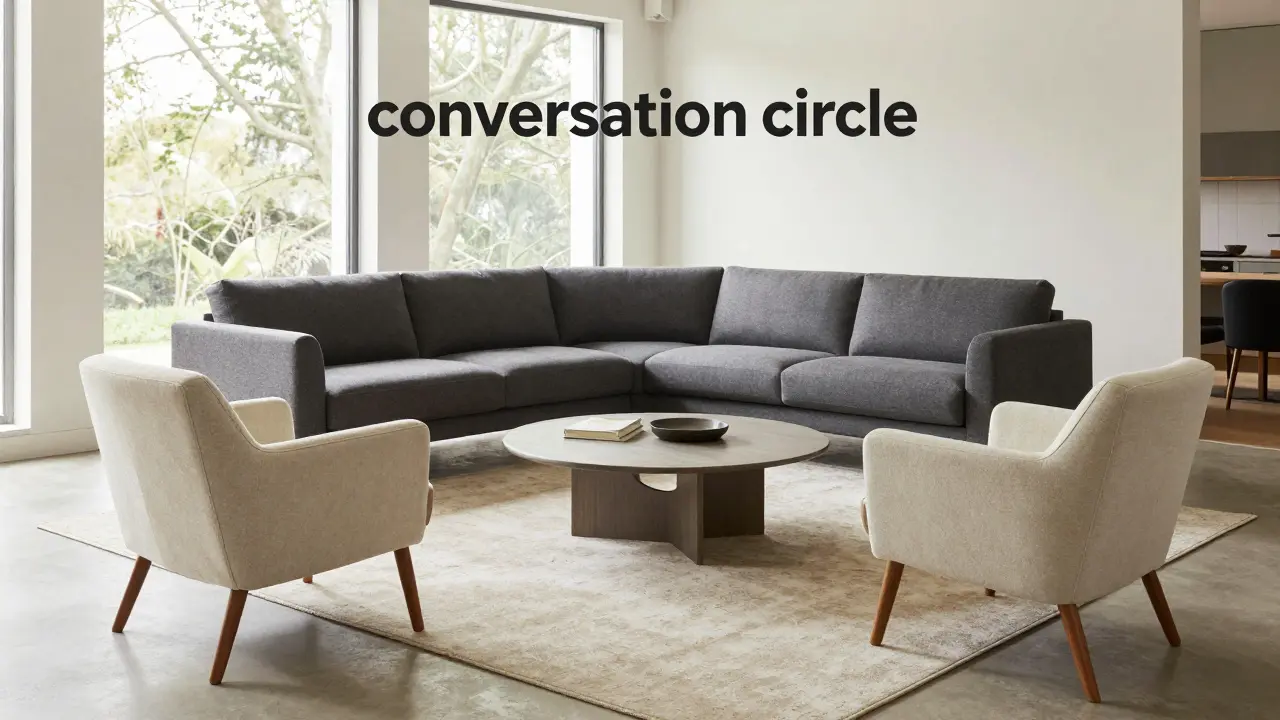
The core idea is simple: you balance your primary seating by pairing two similar items (like armchairs) with three of something else, or alternating groups of two and three to create visual interest. But it's not just about counting legs. It's about creating a 'conversation circle' where no one feels stranded on a lonely island of upholstery. If you've ever struggled with a living room that feels too stiff or a layout that blocks the path to the kitchen, this approach fixes that by breaking up the symmetry just enough to make the room feel lived-in.
Quick Takeaways for Your Layout
- Symmetry vs. Balance: The rule helps you move away from boring, mirror-image rooms toward a balanced but dynamic feel.
- The Conversation Goal: Aim for seating arrangements that keep people within 8 to 10 feet of each other.
- Visual Weight: Use the 2-3 ratio to distribute "heavy" furniture (like sectionals) against "light" furniture (like accent chairs).
- Traffic Flow: Always leave at least 30 to 36 inches of walking space between furniture groupings.
What Exactly is the 2-3 Rule in Interior Design?
In the world of Interior Design, the 2-3 rule is a heuristic for furniture arrangement. It suggests that grouping items in odd numbers or specific pairs prevents the eye from getting bored. When everything is perfectly symmetrical (two chairs facing two chairs), a room can feel like a waiting room at a dentist's office. By introducing a 2-3 dynamic-for example, two lounge chairs paired with a three-seater sofa-you create a visual anchor and a secondary focal point.
Think of it as a way to manage Visual Weight. Visual weight is how much a piece of furniture draws the eye based on its size, color, and texture. A massive velvet sofa has a lot of weight. To balance it, you don't necessarily need another massive sofa; you need a grouping of smaller items-perhaps two slim accent chairs and a small side table-to keep the room from tipping over visually.
If you're working with a smaller apartment, the 2-3 rule prevents you from overcrowding. Instead of cramming five different chairs into a room, you pick two primary seats and three supporting elements (like a rug, a coffee table, and a floor lamp) to define the zone.
How to Apply the Rule to Your Living Room
Applying this doesn't require a degree in art. You just need to look at your room as a series of clusters. Let's break down how to actually execute this based on what you already own.
First, identify your anchor. Usually, this is your sofa. If you have a standard three-seater, that's your "3." Now, you need your "2." This could be two matching armchairs facing the sofa. This creates a classic U-shape that is perfect for chatting. But if you want something more modern and less formal, try two different chairs-maybe one swivel chair and one wingback-to add texture while keeping the count at two.
Next, consider the accessories. If you have two chairs and a sofa, you might add three smaller elements to the periphery: a tall plant, a reading lamp, and a small bookshelf. This 2-3-3 rhythm keeps the eye moving around the room, which actually makes the space feel larger than if everything were pushed against the walls.
| The "Anchor" (The 3) | The "Balance" (The 2) | The Result |
|---|---|---|
| 3-Seater Sofa | 2 Accent Chairs | Classic Conversation Circle |
| 3-Piece Sectional | 2 Ottomans / Poufs | Flexible, Modern Lounge |
| 3 Nested Coffee Tables | 2 Large Armchairs | Symmetry-breaking Focal Point |
| 3 Art Pieces on Wall | 2 Matching Side Chairs | Balanced Vertical and Horizontal Weight |
Common Layout Mistakes the 2-3 Rule Solves
The biggest mistake people make is "Wall Hugging." This is when every piece of furniture is pushed flat against the walls, leaving a giant, empty void in the middle of the room. This happens because people are afraid to occupy the center. The 2-3 rule encourages you to pull your furniture away from the walls. By grouping two chairs and a sofa around a central point, you create a destination within the room.
Another issue is the "Symmetry Trap." We've all seen those rooms where the left side is a mirror image of the right. While it looks clean in a catalog, it feels sterile in real life. By using the 2-3 rule, you break that mirror. Instead of two identical side tables, maybe you use one table and a floor lamp on one side, and a small chest of drawers on the other. You're still balancing the room, but you're doing it with variety rather than repetition.
Finally, there's the problem of scale. People often buy a huge sofa and then realize they have no room for anything else. If you have a "3" that is too dominant, your "2" needs to be visually light. Choose chairs with open legs (like Mid-Century Modern styles) rather than chunky, skirted chairs. This allows the eye to see the floor underneath, which tricks your brain into thinking there is more space than there actually is.
Practical Tips for Different Room Sizes
If you're living in a tiny studio, you can't exactly fit a giant sofa and two armchairs. In this case, apply the rule to smaller objects. Use two pillows and three decorative items on a shelf. Or, use two small stools that can be tucked away and three pieces of wall art. The psychology of the 2-3 balance works regardless of the size of the object.
For those with massive open-concept layouts, the rule helps you create "zones." Instead of one giant sea of furniture, create a 2-3 cluster for the TV area and another 2-3 cluster for a reading nook. A reading nook might consist of two bookshelves (the 2) and three items: a comfortable chair, a small table, and a rug (the 3). This tells the brain that this specific area has a different purpose than the rest of the room.
Don't forget the Rug. A rug acts as the boundary for your 2-3 grouping. If the furniture is just sitting on the floor, the grouping feels accidental. When the front legs of the sofa and both chairs are sitting on a rug, it visually "locks" the 2-3 arrangement together, making it look intentional and professional.
Pro-Tips for Fine-Tuning Your Space
Once you've got your basic 2-3 layout, you can start tweaking the details. One secret is the "Rule of Three" for decor. When styling a coffee table, don't just put one candle on it. Group three items of different heights-like a stack of books, a small vase, and a candle. This complements the 2-3 furniture rule by adding depth to the smaller surfaces.
Also, think about the Color Palette. If your "3" (the sofa) is a dark, heavy color like navy or charcoal, keep your "2" (the chairs) in a lighter tone or a neutral fabric. This prevents the room from feeling bottom-heavy. If you have light-colored furniture, you can use a bold, dark rug to anchor the grouping and provide the necessary contrast.
If you're still unsure, try the "Paper Test." Cut out small rectangles of paper to represent your sofa and chairs. Move them around on a table to see where the 2-3 groupings feel most natural. It's much easier to move a piece of paper than to drag a 200-pound sofa across the room three times an hour.
Does the 2-3 rule work for bedrooms?
Yes, though it's applied differently. Instead of seating, think of it as balancing the bed (the anchor) with other elements. For example, two nightstands (the 2) paired with three decorative elements on a dresser or a bench at the foot of the bed (the 3) creates a balanced, non-clinical feel.
What if I only have a love seat and no extra chairs?
You can still use the rule by incorporating other functional items. Use two poufs or ottomans to act as your "2." These provide extra seating when needed but keep the room feeling open and balanced.
Can I use the 2-3 rule with a sectional sofa?
Absolutely. Because a sectional is so large, it often acts as the "3" (or even more). To balance it, add two distinct accent chairs across from the longest part of the sectional. This prevents the sectional from "eating" the room and keeps the conversation area open.
Is this rule the same as the 60-30-10 color rule?
No. The 60-30-10 rule is about color distribution (dominant, secondary, and accent colors). The 2-3 rule is about physical placement and the number of objects to create visual balance and flow.
How do I know if my furniture is too 'heavy' for the rule?
If you feel like you can't move through the room without dodging furniture, or if the room feels dark and cramped even with the lights on, your pieces are too heavy. Try swapping a solid-base chair for one with legs to create more "negative space."
Next Steps to Transform Your Room
If you're feeling overwhelmed, start with one small change. Move your two favorite chairs to face your sofa instead of putting them side-by-side. Notice how that immediately changes the energy of the room from "watching a movie" to "having a conversation."
For those with larger budgets, consider investing in a few versatile pieces like ottomans or nesting tables. These allow you to switch between different 2-3 configurations depending on whether you're hosting a party or just curling up with a book. Remember, the goal isn't perfection-it's about creating a space that feels intuitive and welcoming.
If you find that your room still feels cramped after applying these rules, it might be time to look at the scale of your furniture. Sometimes, the best way to follow the 2-3 rule is to replace one oversized piece with two smaller, more flexible ones. This opens up the floor plan and lets the layout breathe.

k arnold
April 28, 2026 AT 04:22Oh wow, a whole mathematical formula for where to put a chair. Groundbreaking stuff. I'm sure my living room is just dying for a numeric ratio to tell me how to sit comfortably.
kelvin kind
April 29, 2026 AT 10:19solid tips
Fred Edwords
May 1, 2026 AT 06:58The concept of "Visual Weight" is quite fascinating; however, one must ensure that the textiles are equally balanced to avoid an aesthetic clash!
Tiffany Ho
May 1, 2026 AT 19:02totally agree i tried moving my chairs today and it feels way better now
Ananya Sharma
May 3, 2026 AT 04:23It is utterly reductive to suggest that a simple numeric heuristic can solve the complex psychological dissonance of a poorly designed living space, and frankly, the obsession with these arbitrary "rules" only serves to strip the individuality from a home, turning our private sanctuaries into sanitized, corporate-approved showrooms that prioritize visual symmetry over actual human utility or cultural expression, which is just another symptom of a consumerist society trying to commodify the very concept of comfort through rigid, artificial guidelines that ignore the organic flow of a truly lived-in environment.
Zach Beggs
May 3, 2026 AT 05:40I think the part about not pushing everything against the walls is the most helpful thing here.
lucia burton
May 3, 2026 AT 09:34The spatial dynamics discussed here are absolutely pivotal because when you leverage the synergistic relationship between the anchor piece and the secondary seating clusters, you're essentially optimizing the ergonomic flow of the entire floor plan to maximize interpersonal connectivity and mitigate the restrictive nature of traditional architectural boundaries, which essentially transforms a static room into a high-functioning ecosystem of social interaction where the negative space is just as intentional as the positive mass of the furniture itself!
Sarah McWhirter
May 5, 2026 AT 04:16I bet the people who invented these "rules" are actually just trying to subconsciously manipulate our movement patterns for some weird social experiment. But hey, it looks pretty, right? lol
Sam Rittenhouse
May 6, 2026 AT 09:23It is honestly heartbreaking to think about how many of us have spent years feeling uneasy in our own homes simply because we didn't know about a basic balance rule! My soul actually aches for the version of me that struggled with a giant sectional for a decade!
Denise Young
May 7, 2026 AT 00:00Oh sure, let's just apply some high-level spatial heuristics and pretend that the inherent cognitive load of rearranging heavy furniture is just a minor inconvenience in the quest for a perfectly curated mid-century modern aesthetic that looks like a Pinterest board from 2014, because clearly, the only thing missing from my life was a strict ratio of armchairs to ottomans to finally achieve spiritual enlightenment in my seating arrangement!
Peter Reynolds
May 8, 2026 AT 23:05i think both points are valid in their own way
Ian Cassidy
May 10, 2026 AT 01:09just use the rug to lock it in. low effort high reward.
michael Melanson
May 10, 2026 AT 09:56That paper test is a great idea. Saves a lot of sweat and potential damage to the flooring.