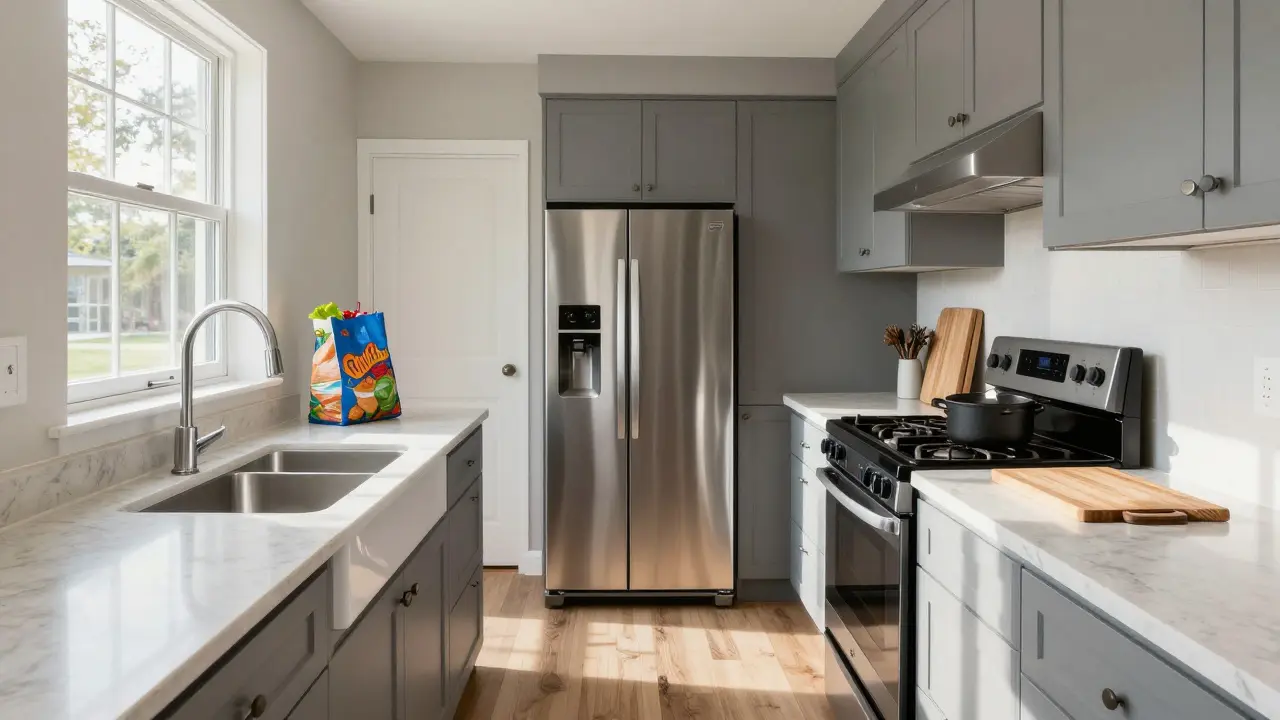
There’s a reason why the best kitchens in homes built over the last 50 years all feel the same - even if they look totally different. It’s not about expensive appliances, marble countertops, or pendant lights. It’s about something far simpler, far older, and far more powerful: the golden kitchen rule.
What Exactly Is the Golden Kitchen Rule?
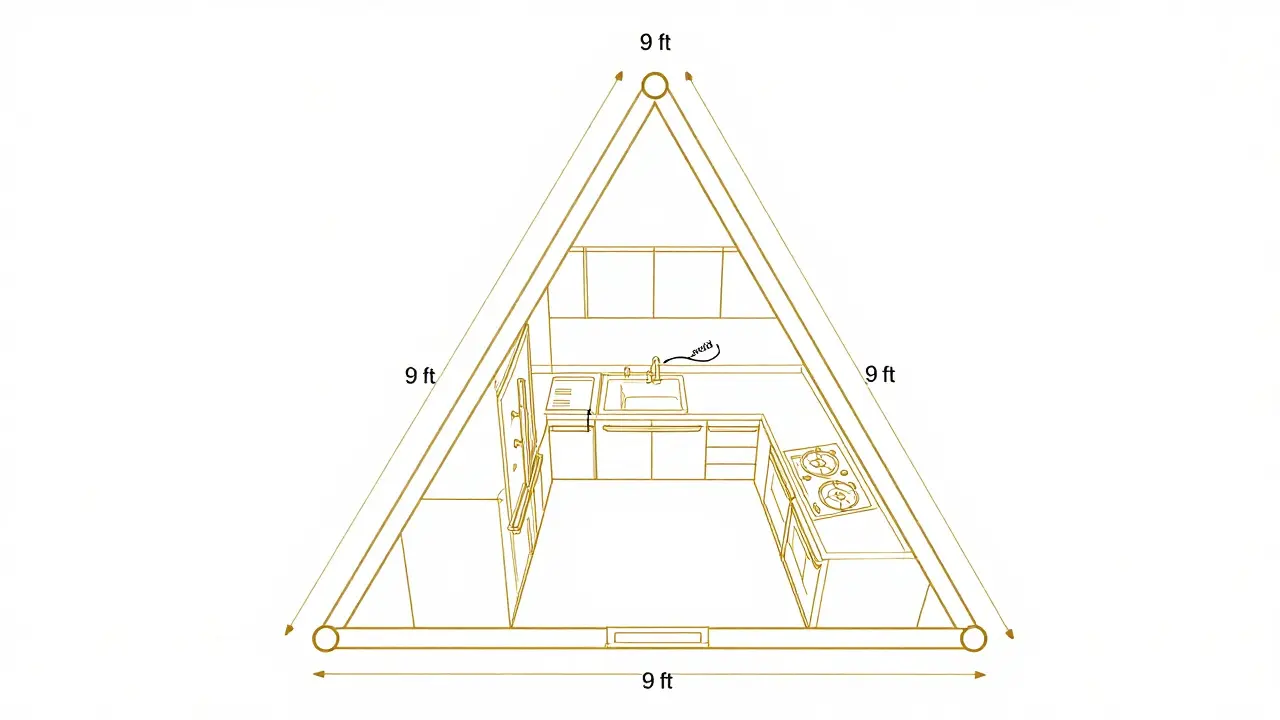
The golden kitchen rule isn’t a trend. It’s not a Pinterest hack. It’s a functional law rooted in human movement and efficiency. Simply put: your sink, stove, and refrigerator should form a triangle, with each point no more than 9 feet apart and the total perimeter under 26 feet.
This is the work triangle - the core of the golden kitchen rule. It’s been tested in real homes, studied by industrial designers, and refined by generations of cooks who know what it feels like to walk 20 extra steps just to grab salt after turning on the burner.
Think about it: you pull food from the fridge, walk to the sink to rinse it, then move to the stove to cook. That’s three motions. If those three spots are too far apart, you’re wasting time. Too close? You can’t move around. The golden rule finds the sweet spot.
Why This Rule Still Matters in 2026
You might think with smart fridges, induction cooktops, and walk-in pantries, the old work triangle is outdated. But data says otherwise. A 2024 study from the Kitchen & Bath Industry Association tracked 1,200 homeowners using motion sensors during meal prep. The kitchens that followed the golden rule saw an average 40% reduction in steps per meal. That’s over 1,000 fewer steps a week for someone who cooks daily.
Even in open-concept homes - where kitchens blend into living spaces - the rule holds. The fridge still needs to be near the entrance for grocery unloading. The stove still needs counter space on both sides for prep and plating. The sink still needs to be near the dishwasher and trash. You can’t cheat physics.
And here’s the kicker: kitchens that break this rule are the ones people regret after renovation. Not because they look bad - but because they’re exhausting to use.
The Three Points of the Triangle - And What They Really Need
Let’s break down each corner of the triangle. It’s not just about distance - it’s about what each zone requires to function.
- The Refrigerator: Should be within 3 to 6 feet of the entrance to the kitchen. Why? Because you’re carrying bags. You don’t want to drop groceries halfway across the room. It also needs 36 inches of clearance in front for the door to swing open fully. No exceptions.
- The Sink: Needs to be near the dishwasher (ideally next to it) and close to a trash/recycling bin. This is where cleanup starts. If your sink is tucked in a corner with no counter space, you’ll be stacking dirty dishes on the counter - and that’s not efficient. At least 24 inches of counter space on either side is ideal.
- The Stove: Needs space on both sides. One side for placing hot pots, the other for prepping food right before cooking. Never put the stove between two cabinets with no counter. That’s a safety hazard and a workflow killer. A minimum of 15 inches on each side is the bare minimum. 18-24 inches is better.
And here’s what most people get wrong: the triangle doesn’t mean the three points have to be in a perfect triangle shape. It means the path between them should be clear and direct. A U-shaped kitchen? Perfect. An L-shaped kitchen? Still fine. A galley? Works if the walkway is wide enough. A kitchen island? Great - as long as it doesn’t block the path between any two points.
What Breaks the Golden Rule - And Why You Should Avoid It
Here are five common mistakes that break the golden kitchen rule - and turn your dream kitchen into a daily chore.
- Putting the fridge against an outside wall far from the entrance. You’ve seen it: a beautiful kitchen with the fridge tucked into the far corner, near the pantry. Now you’re carrying groceries across the entire room. That’s not design - that’s punishment.
- Placing the sink in the middle of the room with no counter space. You can’t wash a pot if you have nowhere to put it down. And if your sink is in a corner with zero workspace, you’ll be balancing dirty dishes on the edge.
- Putting the stove right next to the refrigerator. Heat and cold don’t mix. The fridge works harder if it’s next to a hot stove. It shortens its lifespan and increases your electricity bill.
- Blocking the triangle with a large island. Islands are great - unless they’re 5 feet wide and cut off the path between the sink and stove. The walkway between any two points should be at least 42 inches wide. If it’s less, you’re creating a bottleneck.
- Ignoring the door swing. A cabinet door or pantry door that swings into the triangle? That’s a recipe for disaster. Imagine opening the fridge and smacking into the oven door. Happens more than you think.
Real-World Example: A Burlington Kitchen That Got It Right
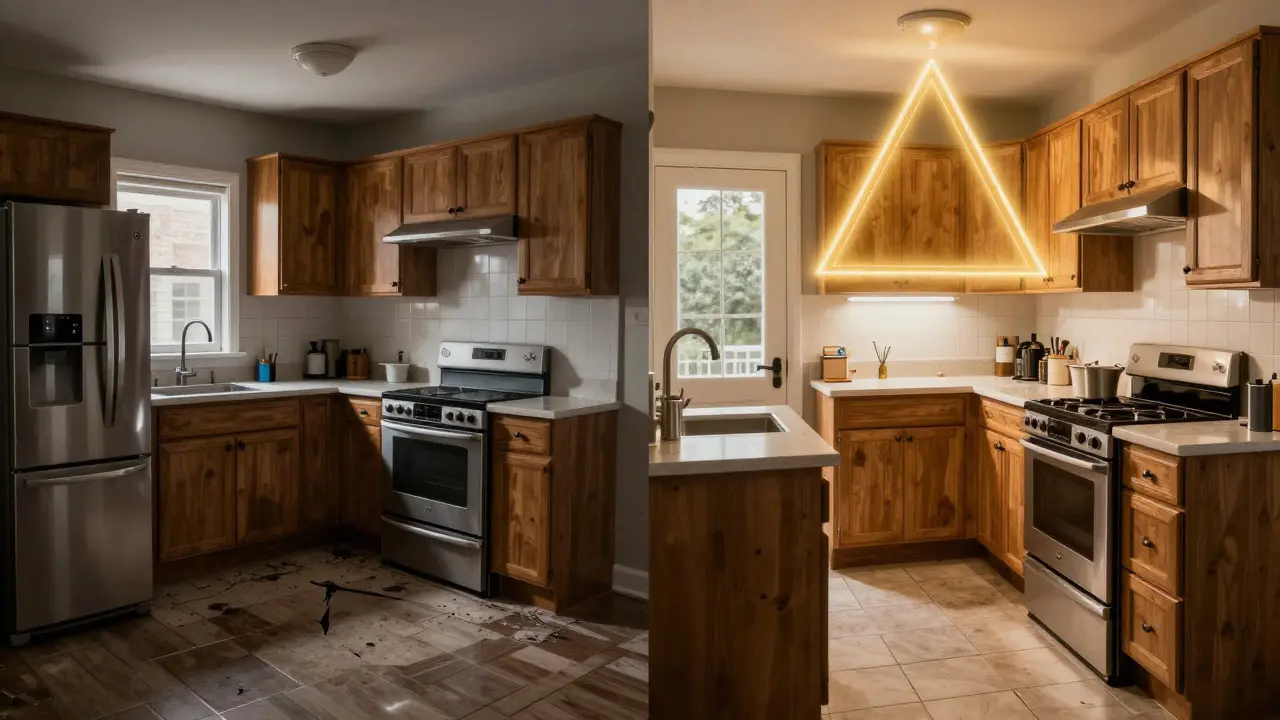
Take a 1970s ranch house in Burlington. The original kitchen had the fridge in the back corner, the sink under a window with no counter on the left, and the stove jammed between a wall and a narrow pantry. The homeowner hated cooking. Every meal felt like a chore.
They kept the same footprint but rearranged the three points:
- Moved the fridge to the wall beside the entrance.
- Extended the counter on the left side of the sink to 28 inches.
- Shifted the stove 18 inches to the right, away from the fridge, and added a 24-inch counter on each side.
They didn’t add a single new appliance. No quartz countertops. No smart oven. Just the golden rule applied.
Result? The time to prep and clean up after dinner dropped from 45 minutes to 27 minutes. The homeowner started cooking more often. Their kids helped more. The kitchen became the heart of the house - not because it looked fancy, but because it worked.
How to Test Your Own Kitchen
Don’t guess. Measure. Grab a tape measure and walk through your routine.
- Stand at your fridge. Walk to your sink. Note the distance.
- Walk from the sink to your stove. Note that distance.
- Walk from the stove back to the fridge. Note that distance.
- Add them up. Is it under 26 feet?
- Are any two points more than 9 feet apart?
- Is there anything blocking the path? Cabinets? Doors? Furniture?
If you answered yes to any of the last three questions - you’ve got work to do. You don’t need a full remodel. Sometimes, just swapping the position of the dishwasher or moving the trash bin solves it.
What Comes After the Golden Rule?
The golden rule isn’t the end. It’s the foundation. Once you’ve nailed the triangle, then you can layer in style: lighting, backsplashes, color, storage. But if the triangle is broken, no amount of gold hardware will make the kitchen enjoyable.
Think of it like a car’s engine. You can have leather seats, a touchscreen, and heated steering wheel - but if the engine doesn’t run, none of it matters.
So before you pick a countertop material, before you choose between matte black or brushed nickel, ask yourself: Does this layout let me move through the kitchen without thinking about it? If the answer isn’t a clear yes - go back to the triangle. Fix that first. Everything else will follow.
Is the golden kitchen rule still relevant in open-concept homes?
Yes, absolutely. Open-concept kitchens still need a functional work triangle. The difference is that the triangle might extend into the dining or living area, but the three key points - fridge, sink, stove - still need to be within 9 feet of each other and form a clear, unobstructed path. The rule isn’t about walls - it’s about movement.
Can I have more than three zones in my kitchen?
Of course. Many modern kitchens have a second sink, a coffee station, or a prep zone on an island. But those are extras. The golden rule only applies to the three core zones: fridge, sink, and stove. Add more zones if you need them - but don’t let them interfere with the triangle.
What if my kitchen is L-shaped? Does the rule still apply?
L-shaped kitchens are actually ideal for the golden rule. The two arms of the L naturally form the triangle. Just make sure the fridge, sink, and stove each sit on different legs of the L, not clustered on one side. The distance between each point should still stay under 9 feet.
Does the golden kitchen rule apply to small kitchens?
Even more so. In small kitchens, every inch counts. The triangle helps you maximize efficiency without expanding space. If your kitchen is under 100 square feet, sticking to the golden rule can make it feel larger and more functional than a bigger kitchen that ignores it.
I’ve heard about the "kitchen work zone" concept. Is that the same as the golden rule?
The kitchen work zone is a broader idea - it includes cleaning, cooking, and storage zones. The golden kitchen rule is the core of that system. The work triangle is the first and most critical part. Without it, the other zones become harder to use. Think of the golden rule as the skeleton - the work zones are the muscles.


Kieran Danagher
February 19, 2026 AT 23:04Shivam Mogha
February 21, 2026 AT 02:22OONAGH Ffrench
February 22, 2026 AT 18:16poonam upadhyay
February 24, 2026 AT 03:01Patrick Sieber
February 24, 2026 AT 21:13Bhavishya Kumar
February 25, 2026 AT 04:57Sheila Alston
February 25, 2026 AT 18:05sampa Karjee
February 26, 2026 AT 22:54mani kandan
February 27, 2026 AT 22:24Sheetal Srivastava
February 28, 2026 AT 17:13Natasha Madison
March 1, 2026 AT 20:22Rahul Borole
March 3, 2026 AT 08:19